

The Asexual Jesus
The subtle heresy we never knew we believed....

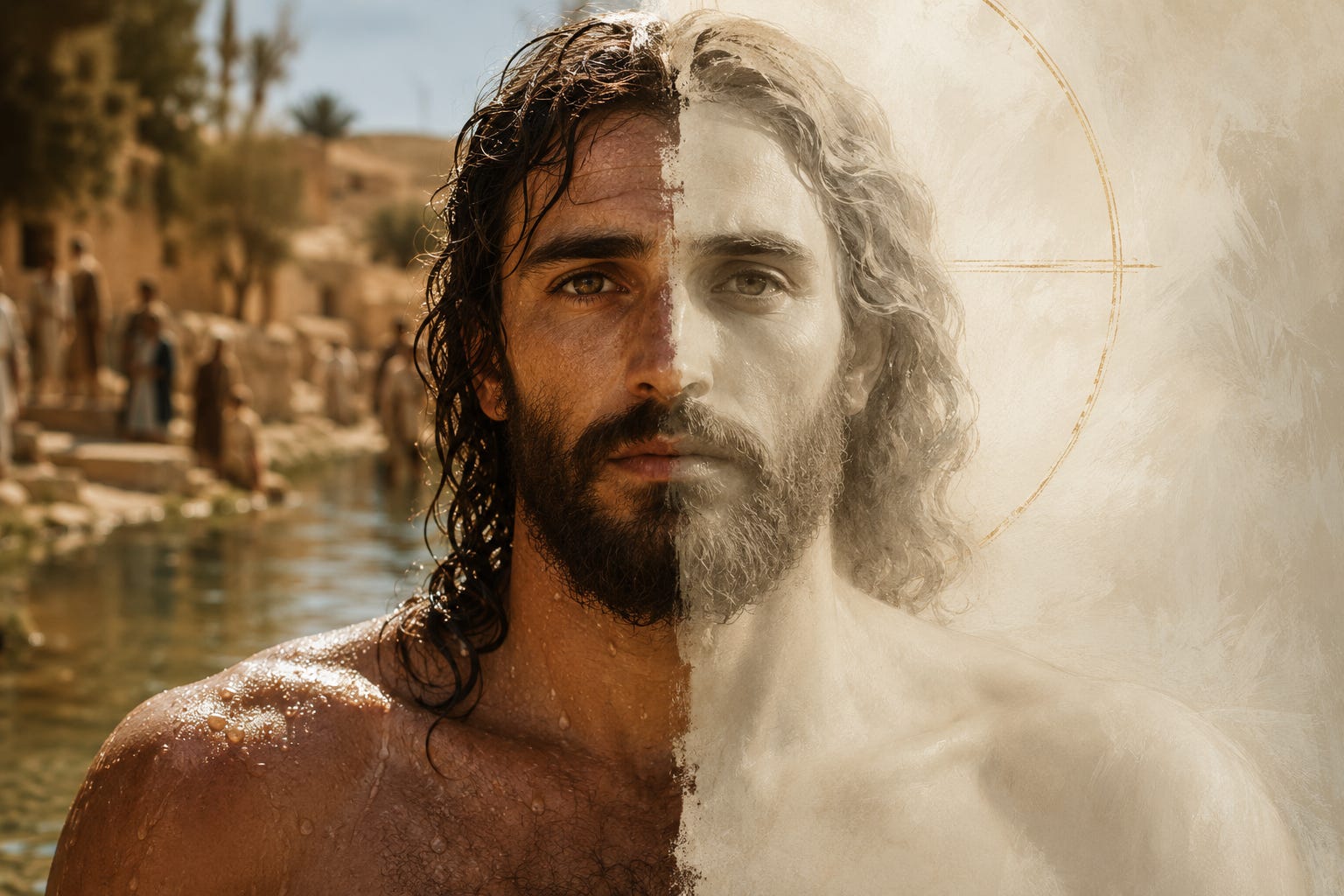
When I was a boy I had a vision of Jesus as a kind of first century hippy.
Peace. Love. Be nice to everyone.
It was based largely on my completely unchurched encounter with Jesus through the wonderfully 1970s film Jesus Christ Superstar.
Then I became a Christian myself about five years later and had an encounter with Jesus that completely changed that picture.
As a young adolescent I had experienced rejection. It had destroyed something inside me. But as a brand new Christian Jesus showed me His own scars. He opened my eyes to the rejection he felt. The hate. The pain.
It was profound.
I suddenly understood that Jesus knew rejection. He had been despised. Rejected. Abandoned by people He loved. He knew what that pain felt like from the inside.
And because He had experienced it, He could meet me in mine. In that experience something happened – by His wounds I was somehow made whole. That rejection was lifted out of my life. My heart felt whole for the first time in years.
But in that moment, Jesus suddenly went from this floaty, love-drugged-up hippy to someone grounded in the harsh reality of human existence.
That Jesus was far more interesting.
Far more powerful.
And far more human.
Over the years I came to know the Jesus of the New Testament. But last year something else shifted.
I realised I had been carrying another distorted picture of Jesus for decades.
I think most Christians have.
We have created an asexual Jesus.
The Jesus we don’t quite believe was human
This happened during a time of prayer when I was talking to God about sexuality and faith, and particularly about some of the things I had been discovering while writing The Yoke We Were Never Meant to Bear.
If I were a hyper-charismatic Christian I could probably describe what happened as a “visitation from heaven”. Jesus came into the room and stood before me.
That would be too dramatic.
It was quieter than that.
But something happened in prayer in which I became profoundly aware of Jesus being right there with me and showing me that he had been a man just like me.
And I mean a man just like me.
Not simply that He got hungry like me.
Or tired like me.
Or hurt like me.
I mean that Jesus inhabited the same kind of male human body that I do.
Including a sexual one.
And bizarrely, that shocked me.
Because despite believing for more than 30 years that Jesus was “fully human”, somewhere deep inside I had quietly inserted an exception.
Jesus was fully human – but not sexual.
Of course nobody actually said that.
It was simply assumed.
Jesus didn’t have those feelings.
Jesus wasn’t sexually aroused. He didn’t get erections. He didn’t discover his body like we did. Jesus didn’t experience sexual attraction.
Jesus didn’t have the embarrassing physical experiences of adolescent boys and young men.
Jesus was “pure”.
And that word gives the whole game away.
Because somewhere along the way we have made sexuality and “purity” opposites.
If Jesus was sexually alive like us then somehow He becomes less holy.
And that tells us something very important.
Not about Jesus.
About us.
Put your seat belt on
Christian theology insists that Jesus was fully human.
This isn’t some optional theological extra.
The New Testament writers fought over it.
Jesus came in the flesh.
Sarx.
Flesh and blood.
Not God pretending to be human. Not God wearing a human costume. Not some divine spirit floating six inches above the dirt.
A man.
We are perfectly happy talking about the bits of Jesus’ humanity that don’t make us uncomfortable.
Jesus got hungry.
Jesus got thirsty.
Jesus got exhausted.
Jesus got angry.
Jesus cried.
Jesus grieved.
Jesus needed sleep.
Jesus sweated.
Jesus bled.
All fine.
But when we start to talk about sexuality and Jesus, suddenly everyone starts shuffling awkwardly in their seats.
Because Jesus also had a male human body.
He had hormones.
He went through puberty.
His body developed sexually.
He experienced the ordinary involuntary physical processes of being male. Erections, ejaculations, pleasure, erotic attraction and feelings.
At this point someone will inevitably shout:
HERESY!
But actually the heresy is much closer to the opposite.
Jesus was tempted
Hebrews says something astonishing about Jesus:
He was tempted in every way as we are, yet without sin.
Every way.
We usually quote that verse because it makes Jesus relatable.
Whatever temptation you face, Jesus understands.
But if Jesus was genuinely tempted as we are then sexual temptation has to be included.
He had to know what attraction felt like.
He had to know what arousal felt like.
He had to know what it was to encounter another beautiful human being and feel something in His body.
Otherwise He wasn’t tempted as we are.
Now let me be very clear about what I am not saying.
I am not saying Jesus had partnered sex.
There is no evidence that He did.
I am not saying He was married.
There is no evidence for that either.
And I am certainly not inventing a secret sex life for Jesus.
I am saying something much simpler.
Jesus had a normal sexuality.
Because human beings have sexuality.
And Jesus was human.
The astonishing thing is that this feels controversial.
We have confused sexuality with sin
This is where I think Christianity has gone badly wrong.
We have become so accustomed to treating sexual desire as morally suspicious that we cannot imagine Jesus experiencing it without somehow contaminating Him.
Sexual attraction becomes “lust”.
Arousal becomes dangerous.
Fantasy becomes impurity.
Pleasure becomes something requiring moral justification.
So obviously Jesus couldn’t have experienced any of that.
He was holy.
But what if sexual desire itself isn’t dirty?
What if arousal isn’t a moral failure?
What if the sexual body isn’t something Jesus had to suppress in order to remain holy?
What if our inability to imagine a sexual Jesus doesn’t reveal His holiness at all?
What if it reveals our shame?
That possibility landed very powerfully with me.
Because suddenly the problem wasn’t Jesus’ sexuality.
It was mine.
Or rather, what Christianity had taught me to believe about mine.
For decades I had unconsciously imagined that becoming more like Jesus meant becoming less sexual.
More controlled.
More detached from desire.
Less interested in pleasure.
Less embodied.
Somewhere at the end of Christian maturity was apparently a man who could walk through life completely untroubled by sex.
Basically an asexual monk.
And we projected that man backwards onto Jesus.
“Can you imagine Jesus doing it?”
Years ago I heard a story about an argument between some prominent British apostolic leaders.
The argument was about masturbation.
Gerald Coates apparently took the position that masturbation wasn’t inherently sinful and challenged the other leaders along the lines of:
“You all do it. Admit it!”
This apparently went down like a cup of cold sick.
The argument became heated and Gerald eventually left their apostolic grouping.
But one of the clinching arguments from the other side was apparently this:
“Can you imagine Jesus doing it?”
Boom.
Case closed.
Because obviously nobody could.
But think about that argument for a moment.
Why couldn’t they imagine it?
The Bible never says Jesus didn’t masturbate.
It doesn’t say He did either.
We know absolutely nothing about it.
The entire argument therefore depends upon an imaginary Jesus.
And the Jesus they imagined was an asexual one.
The logic goes like this:
I cannot imagine Jesus experiencing this sexual behaviour.
Therefore Jesus didn’t.
Therefore it must be unholy.
But perhaps we have got that completely backwards.
Perhaps the reason we cannot imagine Jesus experiencing ordinary sexuality is because we have already loaded it with shame, and guilt?
We built the conclusion into the question.
The soft heresy nobody notices
There was an early Christian heresy called Docetism.
At its simplest, Docetism struggled with the idea that God could genuinely inhabit human flesh.
The physical world was corrupt.
Spirit was pure.
Therefore Jesus couldn’t really have entered corrupted physical existence in the same way we do.
He only appeared to be human.
The church rightly rejected this.
Jesus came in the flesh.
But I think Western Christianity has retained a soft version of the same idea.
Of course Jesus was human, we say.
Just not quite human like us.
He came into the swimming pool of humanity wearing a divine wetsuit.
He got wet enough to understand us but somehow wasn’t contaminated by the water.
And nowhere is this clearer than sexuality.
We have allowed Jesus hunger because hunger isn’t shameful.
We have allowed Him exhaustion because tiredness isn’t shameful.
We have allowed Him grief because grief isn’t shameful.
We have allowed Him anger because anger can be righteous.
But sexual desire?
No.
Because we still believe that sexual desire itself carries contamination.
This is not really a doctrine about Jesus.
It is a doctrine about the body.
And it didn’t come from Jesus.
So where did the asexual Jesus come from?
From the second century onwards Christianity began moving away from its Hebraic roots and absorbing ideas from the surrounding philosophical world.
Stoicism.
Platonism.
Gnosticism.
Later Manichaeism.
Different movements, different beliefs, but with an increasingly familiar suspicion of bodily desire.
The spiritual life became associated with mastery over the body.
Then renunciation of the body.
Then harsh treatment of the body.
Celibacy became spiritually superior to marriage.
Virginity became spiritually superior to sexual experience.
Eventually Augustine would argue that even sex within marriage carried venial fault when motivated by sexual pleasure rather than procreation.
Think about what that does to the Christian imagination over 1,500 years.
The really spiritual person doesn’t need sex.
The really spiritual person masters desire.
The really spiritual person rises above bodily pleasure.
So what must the most spiritual human being who ever lived have been like?
Obviously:
Asexual.
Except Jesus wasn’t a fourth-century Christian ascetic.
He was a first-century Jew.
And that matters.
Jesus came from a culture that wrote the Song of Songs
The Hebrew scriptures are remarkably comfortable with the body.
God creates human beings embodied and calls creation very good.
Men and women desire one another.
They have sex.
They enjoy sex.
And sitting right there in the middle of the Bible is an entire book celebrating erotic desire.
The Song of Songs.
Two lovers longing for each other’s bodies.
Breasts.
Kisses.
Fragrance.
Touch.
Desire.
Erotic anticipation.
Very little embarrassment.
And remarkably little moral anxiety.
We have spent centuries trying to turn it into an allegory about Christ and the Church because apparently two people wanting to get each other’s clothes off is insufficiently spiritual to belong in the Bible.
But it does belong there.
Because erotic desire belongs within human life.
Jesus grew up inside that world.
He knew those scriptures.
He was formed by them.
So perhaps Jesus didn’t experience sexuality as the contaminating force that Western Christians later learnt to experience it as.
Perhaps He experienced desire without shame.
That possibility changes everything.
Something happened to me
During that encounter in prayer I mentioned earlier, I became aware of something else.
Not merely that Jesus understood my sexuality. Or that He wasn’t embarrassed by it. But I felt that during this encounter He showed me how He saw sexuality.
Jesus’ vision of sexual pleasure is completely and radically different to the one we hear about in church.
The closest way I can describe it is to point you to the Song of Songs. This book literally sings it.
Not dirty.
Not corrupt.
Not something God tolerates provided we keep it for making babies or behind moral fencing.
No, sexual pleasure was something to be celebrated – something:
Beautiful.
Powerful.
Joyful.
Life affirming.
Sacred.
A holy fire.
And the word that kept coming to me was:
pure.
That is an odd word to use about erotic desire in Christianity.
We normally use purity to mean the absence of sexuality.
Pure thoughts are thoughts without sex in them.
A pure teenage boy is one who isn’t masturbating.
A pure young woman is one who isn’t thinking sexual thoughts.
A pure Christian marriage is one in which sexual imagination stays safely inside the approved boundaries.
But what if we have misunderstood purity?
What if sexual desire can itself be pure?
Not because everything we might do sexually is therefore good.
Of course not.
Sexuality can be exploitative.
Selfish.
Violent.
Manipulative.
Destructive.
Like every powerful part of human nature it can be used to harm.
But the existence of destructive sexuality doesn’t make sexuality itself dirty any more than gluttony makes food dirty.
Desire itself is not the enemy.
This changed something in me
For most of my Christian life I have carried a subtle tension between my sexuality and my spirituality.
I didn’t always notice it.
But it was there.
Sex belonged in one room.
God belonged in another.
You could move between the rooms, obviously.
But you tidied yourself up first.
I don’t believe that anymore.
Because if Jesus really entered human existence then He entered all of it.
The body isn’t the embarrassing container carrying the spiritual bit of us around.
Our sexuality isn’t some unfortunate biological drive that God reluctantly permits under licence after marriage.
We are embodied human beings.
Sexual beings.
Spiritual beings.
There isn’t a clean line dividing them.
And Jesus stands right in the middle of that integration.
Fully God.
Fully human.
Fully embodied.
And yes.
Fully sexual.
I think some Christians will find that sentence deeply uncomfortable.
I understand why.
It once made me uncomfortable too.
But perhaps we should sit with that discomfort for a moment rather than immediately trying to make it disappear.
Because the discomfort might be telling us something.
If imagining Jesus hungry doesn’t disturb us...
If imagining Jesus sweating doesn’t disturb us...
If imagining Jesus naked on a Roman cross doesn’t disturb our theology...
But imagining Him experiencing sexual arousal does...
Then perhaps the problem isn’t Jesus.
Perhaps after nearly two thousand years of Christian suspicion towards the body, we still haven’t quite made peace with the incarnation.
We say the Word became flesh.
Maybe it’s time we actually believed it.
Endnotes
1. 1 John 4:2–3. The reality of Jesus coming “in the flesh” was not peripheral to early Christianity. See also John 1:14 and 2 John 7.
2. Hebrews 4:15. The text says Jesus was tempted “in every way, just as we are—yet he did not sin.” My argument that this necessarily includes the sexual dimension is an inference from the universality of that statement, rather than something Hebrews explicitly discusses.
3. Docetism was an early Christian tendency to deny or diminish the reality of Christ's physical humanity, presenting his embodied existence and suffering as in some sense merely apparent. I use “soft Docetism” in this article to describe something less explicit: affirming that Jesus was fully human while unconsciously exempting him from aspects of ordinary embodied human experience.
4. See Ignatius of Antioch, Letter to the Smyrnaeans, especially chapters 1–7, for an extraordinarily early insistence upon the real flesh, suffering and resurrection of Jesus against those who denied it.
5. Augustine, De Bono Coniugali (On the Good of Marriage). Augustine regarded marital intercourse for procreation as blameless, while intercourse undertaken to satisfy sexual desire carried venial fault.
6. For the rise of sexual renunciation and ascetic attitudes in early Christianity, see Peter Brown, The Body and Society: Men, Women, and Sexual Renunciation in Early Christianity.
7. See Song of Songs 1:2; 2:3–6; 4:1–7; 7:6–9 for the remarkably uninhibited celebration of embodied erotic desire within Hebrew scripture.
Wow. I have never thought about this but you are correct!